
OCCAM Members meet in Shetland
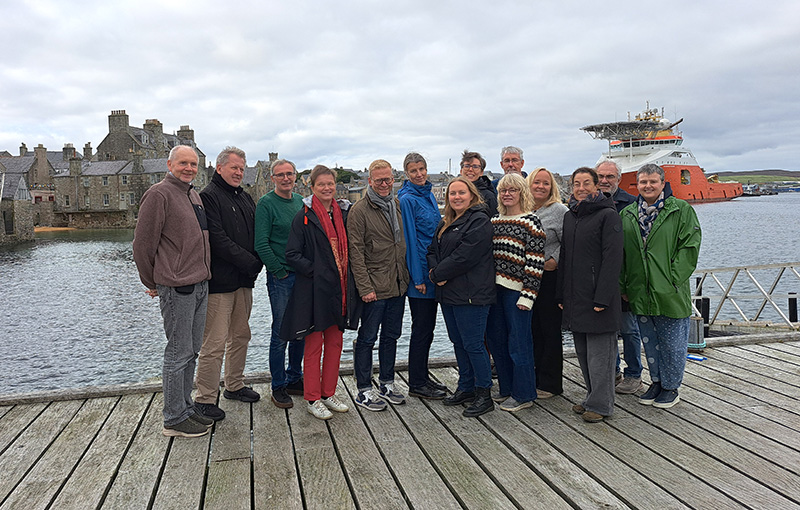
Project partners of OCCAM – the Horizon Europe initiative developing innovative, science-based solutions to help the European aquaculture sector adapt to and mitigate climate change – met in Lerwick for two days this week (Tuesday 15 and Wednesday 16 September).
The group, Operationalising Climate Change Adaptation and Mitigation (OCCAM) in European Aquaculture has brought together industry, scientists and policymakers to foster cross-sector collaboration, and are piloting a series of solutions over a four-year period to reduce environmental impact while ensuring economic viability and supporting smarter, climate-resilient decision-making throughout the aquaculture value chain.
As climate change poses an increased risk to marine ecosystems and coastal communities, OCCAM’s work is timely and vital for European aquaculture.
The project partners are from Norway, Belgium, Denmark, the Faroe Islands, Germany, Iceland, Poland, Spain, Sweden, Scotland (and Shetland) and are progressing a number of solutions including the earliest possible detection of harmful algal blooms that may impact shellfish growing in Scottish waters.
Delegates attending the Shetland meeting discussed the progress of the project ahead of an important 18-month milestone, hearing how the first solution prototypes are developing across the nine case studies – from carp farming in Poland and rainbow trout in Spain, salmon in the Faroe Islands and Iceland, mussels and oysters in Scotland, oysters and seaweed in Sweden, and aquaculture equipment in Norway, and considered how the findings can be taken up in policy and practice.
Petter Olsen, OCCAM coordinator, said: “We’re very happy to be hosted by Seafood Shetland and to get to meet local mussel producers. For our Shetland case, we build on the work done by the Scottish Association for Marine Science (SAMS), where the focus is on early detection of harmful algal blooms and associated risk assessment, which is a very important issue for mussel farmers both in Shetland and elsewhere.”
Chief Executive of Seafood Shetland, Ruth Henderson, said: “Seafood Shetland is pleased to be an active participant in OCCAM. Our seafood industry depends on the natural environment, so it is vitally important that we collaborate with our European partners in aquaculture to share knowledge, adopt best practice, and do what we can to secure a sustainable future.”
Further information: https://occamproject.eu